Old Way vs VegaDigi Way: Building Internal Business Management Software From Scratch vs Starting With a Ready Foundation
· VegaDigi Journal
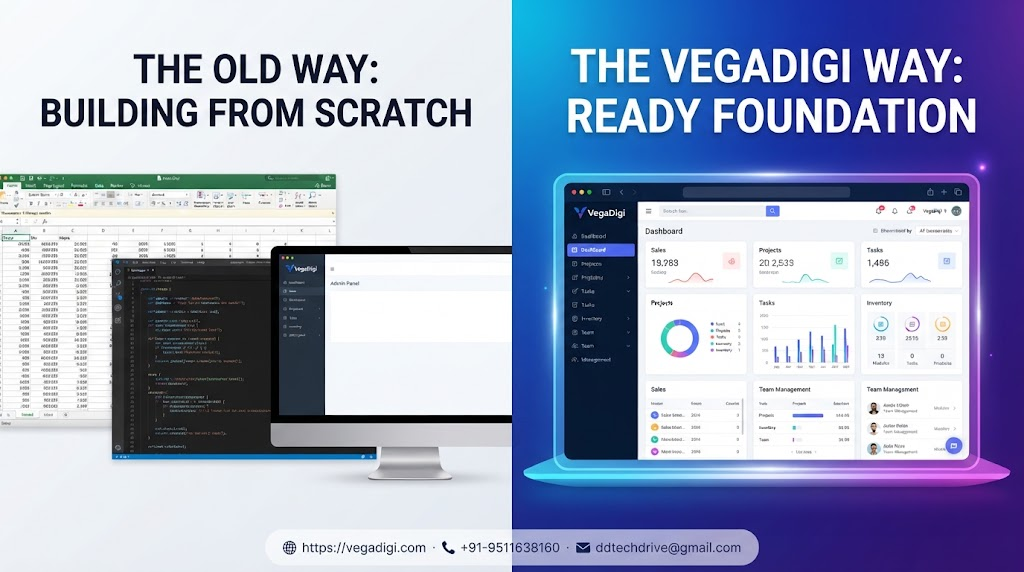
If you have ever tried to run a growing business on a stack of spreadsheets and a freelancer on standby, you already know the pattern. Something breaks, someone builds a patch, and six months later the internal system is a maze only one person understands. This post walks through what that old workflow actually looks like next to a different approach: starting from a ready business management software foundation and customizing it.
The Old Way, Stage By Stage
Most teams start with a spreadsheet because it is fast and free. Inventory, staff records, orders, invoices - all tracked in tabs that multiply over time. Eventually someone says we need real software, and the next step is briefing a freelancer or in-house developer module by module: first the database, then the admin panel, then reports, then a dashboard. Each module gets tested on its own, integration bugs show up late, and requirements often shift halfway through because nobody mapped the full workflow up front. It works, eventually, but it is slow and every business ends up rebuilding the same basic pieces - login systems, role permissions, reporting screens - that thousands of other businesses have already built before.
Starting From a Ready Foundation Instead
This is where a marketplace like VegaDigi changes the starting point. Instead of opening a blank project file, you look through ready-made business management software, pick something close to what you need, and customize it. The core structure - data models, admin views, basic reporting - is already there. Your work shifts from building the skeleton to shaping it around your actual processes: your fields, your permissions, your branding, your workflow quirks.
To be clear, this is not a claim that the software becomes a finished, ready-to-run business system the moment you buy it. Customization and setup are still real work, and how much depends entirely on how close the ready-made product is to your requirements. What changes is the starting point - you are adapting something functional instead of assembling it from nothing.
Where the Time Actually Goes
In the old way, a large chunk of project time goes into building common infrastructure: authentication, user roles, basic CRUD screens, initial report layouts. None of that is unique to your business - it is the same scaffolding nearly every internal tool needs. Starting from an existing product means that scaffolding is already built, and your customization time goes toward the parts that are actually specific to you.
When the Old Way Still Makes Sense
If your business logic is highly unusual, or you need something no existing product resembles, building from scratch with a dedicated developer is still the right call. Ready-made source code is a starting point, not a universal answer for every requirement.
My Take
If your internal tools are still living in spreadsheets and the plan is to hire someone to build everything module by module, it is worth browsing a marketplace like VegaDigi first. If something close to your workflow already exists, customizing it will almost always get you further, faster, than starting from an empty project - just budget real time for the customization and setup stage, because that part does not disappear.