The Break-Even Point: How Many Saved Development Hours It Takes for Ready-Made Source Code to Pay for Itself
· VegaDigi Journal
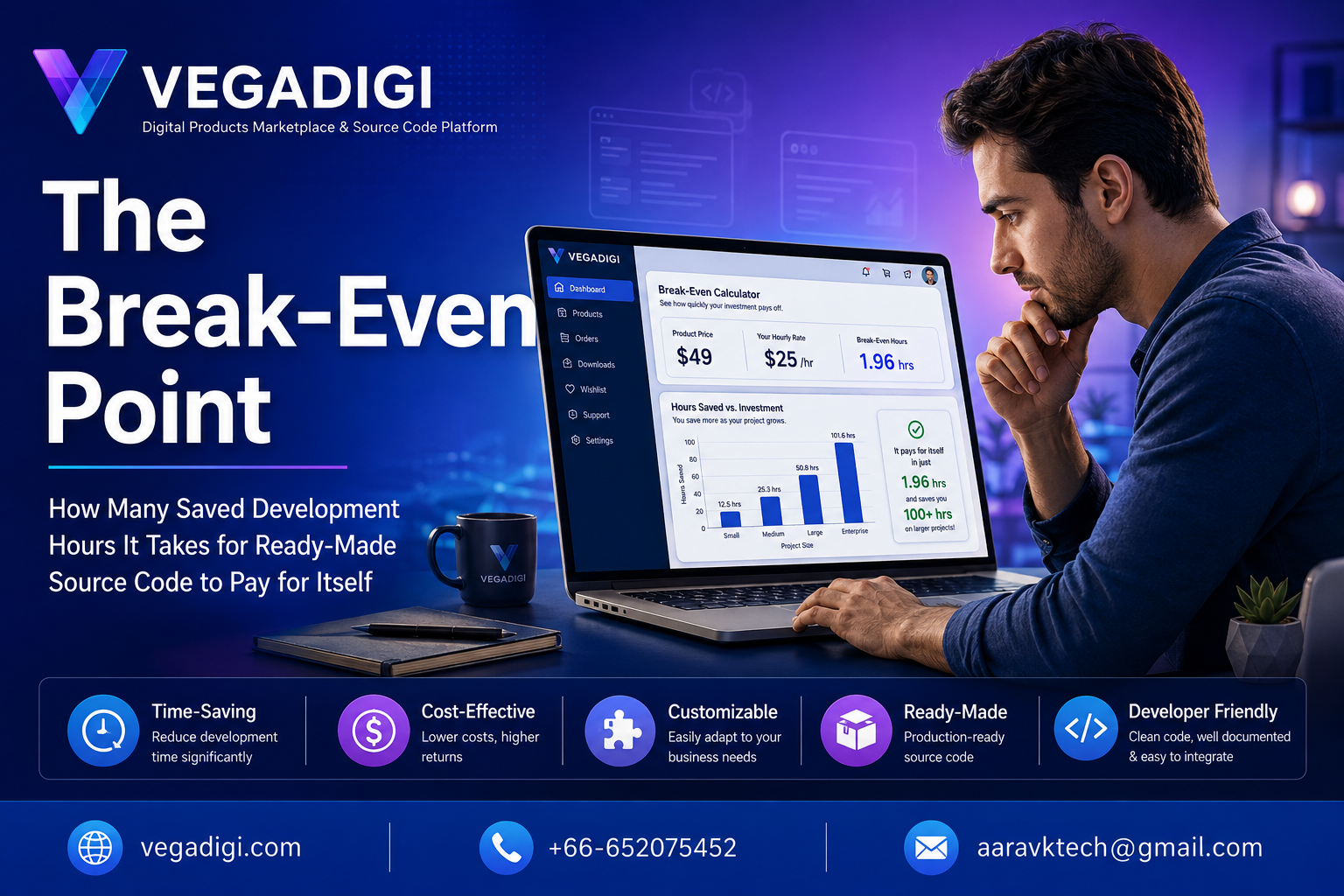
If you've ever started a new project and thought I'll just build the login and dashboard myself, it'll only take a couple of days, you already know how that story usually ends. What looks like a two-day task quietly turns into two weeks once you factor in edge cases, testing, and the inevitable rebuild. This is exactly where the idea of a break-even point becomes useful — a simple way to figure out whether building from scratch or starting with ready-made source code actually makes more financial sense for your project.
What break-even actually means here
Break-even, in this context, is the moment where the money you'd spend building something from zero equals (or exceeds) the price of buying it ready-made. Once you cross that point, every hour you save by not rebuilding the basics is essentially free time you can put toward customization, testing, or your next client project.
The simple formula founders and agencies use
It doesn't require a spreadsheet full of formulas. Estimate the hours it would take to build the core foundation — authentication, dashboard, admin panel, basic workflows — then multiply that by your hourly rate or your team's effective cost per hour. Compare that number to the price of a comparable ready-made source code package. If the hours-based number is higher, you've already found your break-even point before writing a single line of code.
Why developers underestimate the real hours
Most time estimates only account for the happy path — the version of the feature that works perfectly on the first try. Real development includes debugging, handling edge cases, adjusting for different devices, and revising after testing. Those extra hours rarely get counted upfront, which is exactly why the true cost of building from scratch is often higher than it first appears.
Where ready-made source code changes the equation
On a marketplace like VegaDigi, ready-made source code covers the categories developers rebuild most often — WordPress themes and plugins, PHP scripts, SaaS starters, Android app source code, and e-commerce foundations. Starting from one of these doesn't remove the need for customization or setup, but it does mean the foundational hours are already behind you, which is usually where the biggest chunk of early development time goes.
A quick way to sanity-check your own project
Before your next build, try writing down just three numbers: your estimated hours to build the foundation from scratch, your hourly cost, and the price of a comparable ready-made source code package on VegaDigi. That's usually enough to see which side of the break-even line your project falls on.
My take: if you're a solo developer or a small team working on a tight timeline, the break-even math almost always favors starting with a ready-made foundation — the hours saved on the boring, repetitive parts add up faster than people expect. If you're building something highly specialized with no existing equivalent, custom development from scratch may still be the right call. But for common project types — booking apps, e-commerce stores, SaaS dashboards — it's worth running the numbers before you open a blank code editor.