The Real ROI Math: What Ready Source Code Actually Saves You in Hours and Money
· VegaDigi Journal
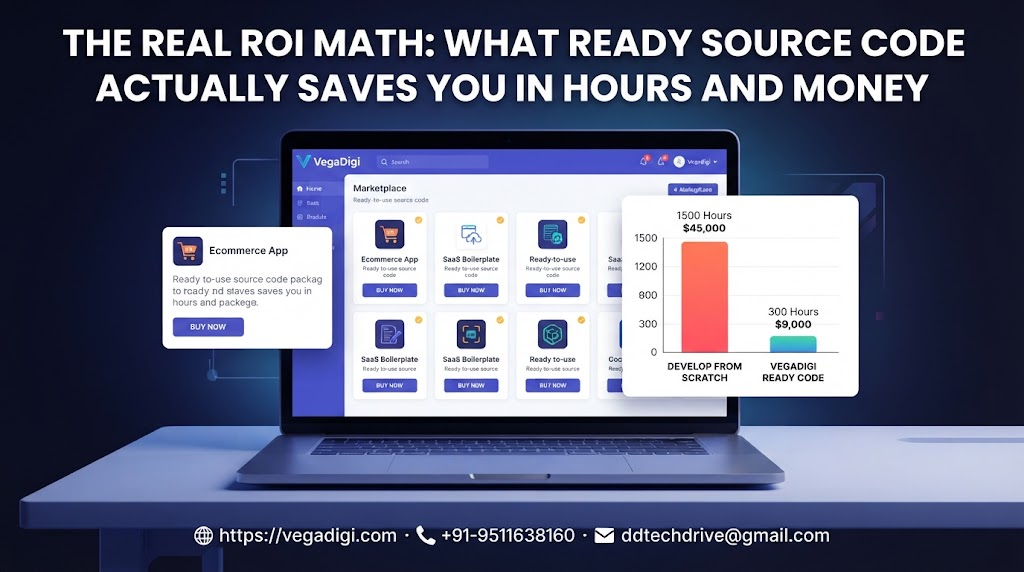
Every development project starts with the same quiet question: how much of this actually needs to be built from scratch? If you have ever sat down to start a new app, website or SaaS product, you already know the answer usually is not flattering. A huge share of any project is the same recurring foundation — login systems, admin panels, dashboards, basic CRUD screens — rebuilt again and again across projects that are, at their core, different businesses solving different problems.
This is where the real return-on-investment conversation begins, and it is less about money upfront and more about where your hours go.
Why the foundation eats more time than founders expect
Most teams underestimate how much of a build is foundational plumbing rather than unique product work. Authentication, role permissions, basic dashboards and settings pages do not differentiate your product from a competitor's — but they still have to work, and they still take real hours to build and test. When those hours go into rebuilding the same components a hundred other projects already solved, that is time not spent on the parts of your product that are actually yours.
What changes when you start from a foundation instead
Starting with ready-made source code from a marketplace like VegaDigi does not remove development work — it repositions it. Instead of spending early weeks on infrastructure, you spend that time on customization: adjusting the UI to match your brand, wiring in your specific business logic, and setting up the parts that make the product genuinely yours. The work is still real. It is just aimed at the right target from day one.
The effective hourly rate shift for freelancers and agencies
For freelancers and agencies charging per project, this matters even more. If a chunk of billable hours goes into rebuilding a login flow you have built a dozen times before, your effective rate on that project quietly drops. Starting from an existing foundation lets you redirect those hours into the customization and delivery work clients are actually paying for — and that is a more honest use of both your time and their budget.
What this does not mean
It is worth being direct here: starting from ready source code is not a shortcut to zero work. It is not a guarantee that any given script becomes an instant business, and it is not a replacement for testing, configuration and thoughtful customization. What it changes is the starting point — you are customizing and building on top of something functional, rather than architecting every layer from an empty file.
My take: if you are a solo developer or small team constantly rebuilding the same core systems project after project, it is worth browsing a marketplace like VegaDigi before your next kickoff call. Look specifically in the category closest to your next project — SaaS, PHP, Android, WordPress or e-commerce — and treat the source code as your starting layer, not your finish line. The time you save on the foundation is time you can actually spend making the product good.